Fashion has often been compared to a nightmare — garments that restrict the body, standards that distort the soul, and a value system teetering toward the grotesque. Rarely, however, has a designer leaned into that metaphor as boldly as Jonathan Anderson did at his debut women’s wear show for Dior.
Before a single model walked the runway, Anderson opened with a horror film projected onto an upside-down pyramid suspended above the stage. Directed by British documentarian Adam Curtis, the film presented Dior as a haunted house, filled with the ghosts of its legendary designers — from Christian Dior and Yves Saint Laurent to John Galliano and Maria Grazia Chiuri. Mixed in were flashes of blood, lightning, screams, and scenes spliced from past fashion spectacles, creating a surreal blend of Hitchcock and “The Devil Wears Prada.”
Revisiting Dior’s Shock Factor
The short film reminded audiences that Dior was never meant to be purely safe or predictable. When Christian Dior first launched his collections in postwar France, some spectators were scandalized by the extravagance. Anderson’s collection echoed this spirit, positioning Dior not as an untouchable institution but as a living laboratory.
Breaking and Rebuilding Dior Codes
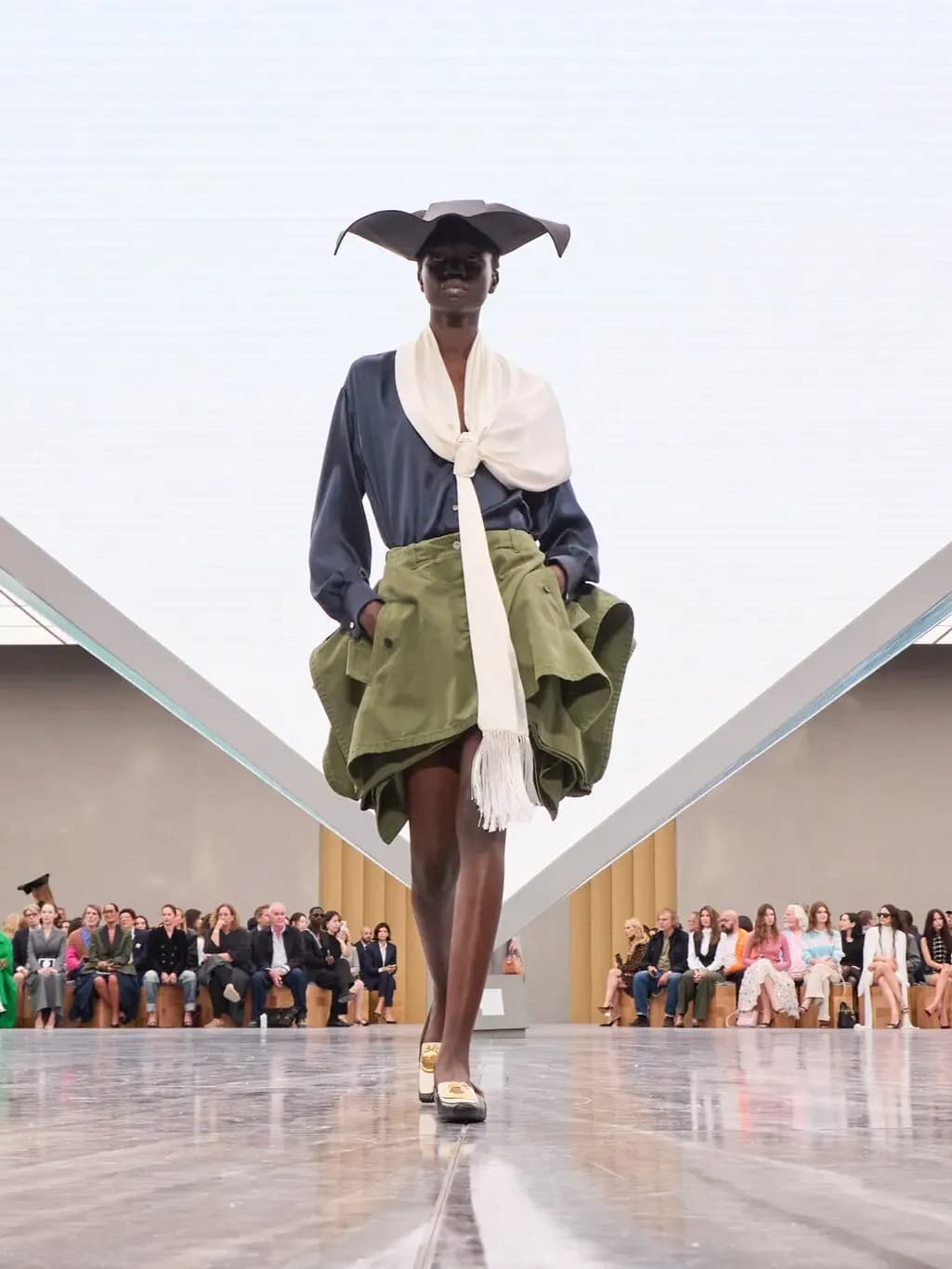
Anderson dismantled Dior’s most recognizable elements and reassembled them in unexpected ways. The classic bar jacket, reduced to doll size, was paired with pleated skirts of the same proportion. Peplums became oversized bows layered over denim minis. Sleek satin dresses expanded into basket-weave structures, while jersey gowns were stretched across bulbous panniers resembling exercise balls.
A halter dress crafted from hundreds of ivory beads referenced Dior’s iconic 1949 Junon gown, reimagined for today’s audience. Some pieces felt playful and exaggerated, while others pushed the boundaries of practicality.
Playful Extremes
The collection explored the tension between fantasy and daywear. Knit capes paired with jeans mirrored looks from Anderson’s men’s wear line, while skirts with duck-like frills carried over from his earlier work. Hats combined the silhouette of a French military tricorn with futuristic jet wings. These whimsical gestures recalled Anderson’s Loewe and JW Anderson designs.
The show also included a lighter tone — a sense of humor absent from Dior for years. At one point, Anderson even hinted that.
Who Is the New Dior Woman?
If anything was unclear, it was the precise identity of the Dior woman Anderson envisions. She is experimental, rejects convention, and likely is not the embodiment of traditional formality. Anderson described the “messiness” as deliberate, offering something for everyone.
While the presentation may unsettle Dior’s more conservative clients, it ultimately stopped short of true horror. Instead, it was theatrical, bold, and — as promised — a scream.