A$AP Rocky, Jon Bon Jovi, Teyana Taylor and a cast of cultural icons boarded the C train as fashion descended underground.
It is not every day you spot A$AP Rocky on a subway platform, much less alongside Deeda Blair, Kristen Stewart, Bowen Yang, Solange or Jon Bon Jovi. It is even rarer to find a fashion house turning a New York City station into a catwalk. But that was exactly the scene as Chanel staged its latest Métiers d’Art show beneath the streets of Manhattan.
Models glided across a platform beside a motionless train, wearing evening gowns trimmed with feathers, dripping in beads and cut from leopard prints. The location was an abandoned downtown station at Bowery and Kenmare, filled not with commuters but with haute couture and celebrities wrapped head to toe in Chanel — bouclé coats, quilted bags, earmuffs, boots and portfolio cases set against tiled walls and rails.
From Temple of Dendur to transit lines
The last time Chanel presented a Métiers d’Art collection in New York was in 2018, when Karl Lagerfeld transformed the Temple of Dendur at the Metropolitan Museum of Art into a spectacle of gold and Egyptian references. The contrast between that monumental setting and a stalled subway platform could not be sharper.
Yet the intention was clear. Matthieu Blazy, appointed artistic director just over a year ago, was not interested in repeating history. After the passing of Lagerfeld and the transitional period under Virginie Viard, Chanel had reached a crossroads. Blazy was hired to inject energy, risk and imagination back into the house, and he did so not by elevating Chanel to a pedestal, but by bringing it directly into public life.
A wardrobe for real characters, not archetypes
If Blazy’s debut show in Paris earlier this year introduced his vision through a cosmic dreamscape inside the Grand Palais, the New York presentation flipped the narrative: this was Chanel on the ground, among real people. Each look suggested a different personality rather than a prescribed ideal.
Classic tweed suits appeared woven to resemble leopard print, as if designed for boardroom predators rather than drawing rooms. Jeans were not denim at all but faded silk trousers, frayed with glistening beadwork. What looked like flannel shirts turned out to be bouclé illusions. One tweed jacket was worn over a Superman T-shirt. Another outfit featured a coffee cup dangling from a handbag chain.
Eveningwear expanded significantly this season. There were short black dresses with raised waists and ’60s flounced hems, long gowns with flapper energy, silver-sequined silhouettes and devoré fabrics that seemed destined for red carpets as awards season approaches.
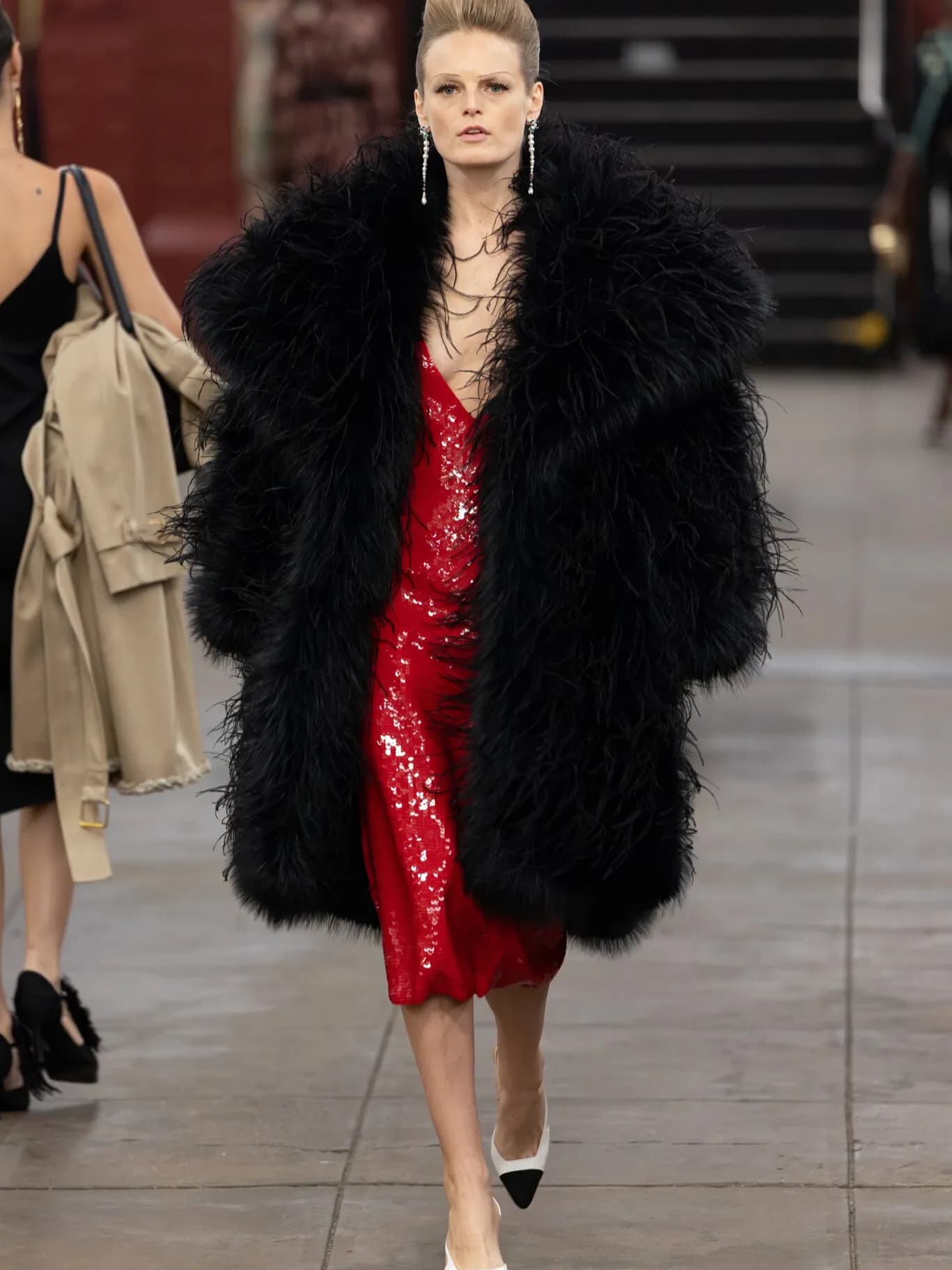
Hanne Gaby Odiele wore a red sequined sheath beneath an oversized black feathered jacket, her hair sculpted into a dramatic chignon as she stared impatiently down the tracks like a socialite late for the opera. Alex Consani leaned against a pillar in double-breasted pinstripes, looking every bit like a dealmaker killing time. Long feathered tops were tied over slouchy trousers and T-shirts. This was not a uniform — it was an ecosystem.
Reinventing Chanel without repeating it
After the show, Blazy admitted this collection allowed him to explore eveningwear more fully for the first time. He also made a point of what was missing. There were no obvious double-C logos, no camellias, no signature strands of pearls. And yet nothing felt anything but Chanel.
Rather than leaning on symbols, Blazy is rebuilding the brand through codes of attitude, tailoring and texture. In two collections, he has already loosened Chanel’s grip on nostalgia and opened space for something contemporary to grow.
Pointing to a flannel-style overshirt, Blazy referred to it as “a new classic.” Chanel already has its iconic jacket, he said. Perhaps this could become his.
Why New York, and why the subway
The decision to bring the show to New York was both personal and strategic. The United States remains Chanel’s largest market for ready-to-wear. Coco Chanel herself drew inspiration from the city during a visit in 1931, which also took her to Hollywood.
For Blazy, the connection runs deeper. Early in his career, he lived and worked in New York while employed at Calvin Klein. The subway, he said, fascinated him because it represents a world without hierarchy.
“All strata of society use it: students, musicians, innovators,” he explained. “I wanted to capture the happy chaos you feel every morning — you never know what you are going to meet around the corner.”
Sometimes it is a rushing parent. Sometimes it is someone dressed as Spider-Man.
To many New Yorkers, that romantic vision may sound naïve, especially given how daily transit has become a symbol of burnout and decline. But for one night, at least, Blazy turned underground travel into something unexpectedly beautiful — and reminded the city that fashion, even at its most luxurious, still belongs to the street.