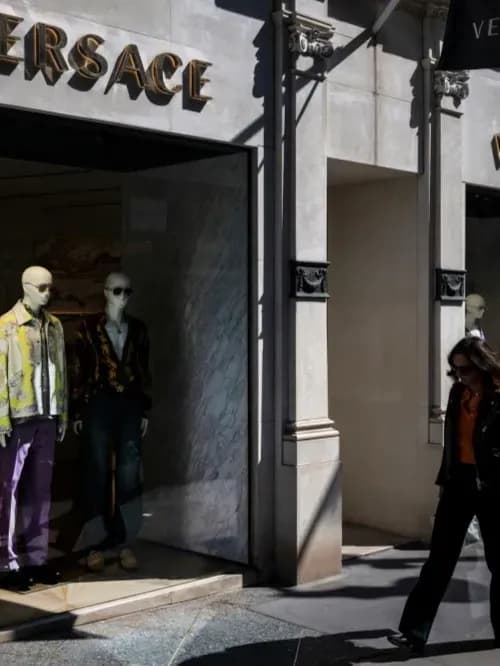
Prada Group has officially completed its acquisition of Versace in a deal valued at approximately $1.4 billion. The agreement brings together two of Italy’s most influential fashion houses, uniting Versace’s bold glamour with Prada’s intellectual minimalism under one corporate roof.
The acquisition marks one of the most significant moves in luxury fashion in years, reshaping the Italian market and strengthening Prada’s position among global luxury groups. Versace had previously been owned by Capri Holdings and had struggled to regain full momentum following the pandemic. Prada views the purchase as a long-term strategic investment built on craftsmanship, brand power and international scalability.
What the Deal Means for Both Brands
Versace will now become part of Prada’s industrial and production network in Italy. The integration process is already underway and is expected to improve efficiency, supply chain control and product consistency across categories.
Leadership of Versace’s next chapter will be overseen by Lorenzo Bertelli, who takes on the role of Executive Chairman. The company has confirmed that there are no immediate plans for major management restructuring, signaling stability rather than disruption.
For Prada, the deal expands its influence into a more expressive and sensual segment of luxury. For Versace, it provides access to a production ecosystem known for quality control and long-term brand development.
Creative Reset Under New Direction
Versace is already undergoing a creative reset. In early 2025, the brand appointed Dario Vitale as its new creative director following his tenure at Miu Miu. His debut collection introduced a sharper, more modern retail-focused approach while preserving the house’s distinctive identity.
Prada is expected to support this transition by offering operational stability while allowing creative independence to remain intact. Rather than diluting Versace’s flamboyance, the group aims to sharpen it — refining execution without compromising personality.
A Shift in the Luxury Landscape
The takeover signals a consolidation trend among legacy European fashion houses, as scale, efficiency and brand control become essential in a volatile retail environment. With Versace now part of the Prada ecosystem, Italy’s fashion sector enters a new era in which fewer companies hold greater creative and economic power.
For consumers, the merger promises evolution rather than erasure. Both houses are expected to maintain their identities — only now with shared resources and broader global ambition.