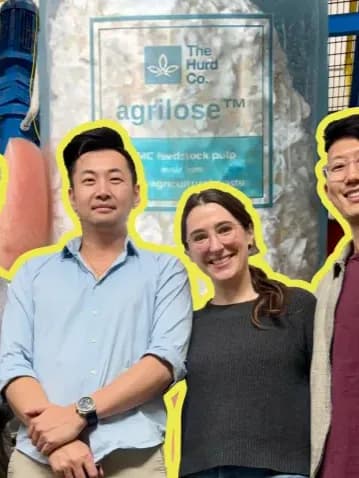
In the heart of California, a young company called The Hurd Co. is reimagining what fabric can be made of. Instead of cutting down trees or relying on fast fashion’s synthetic fibers, this startup turns agricultural waste — such as leftover hemp cores — into a new material for clothing.
The company’s founders, Taylor Heisley-Cook and David Mun, first met at the University of California, Santa Barbara. What began as a student thesis at the Bren School of Environmental Science and Management has grown into a pilot facility capable of producing 10 kilograms of pulp per day — enough to craft sample garments from their new fabric.
What Exactly Is a “Hurd”?
A “hurd” is the inner woody core of the hemp plant, left behind after removing its fibers, seeds, and flowers. Although it accounts for up to 90% of the plant, it has traditionally been treated as waste. The Hurd Co. saw opportunity where others saw residue — transforming these discarded materials into Agrilose, a sustainable cellulose pulp used to create soft, drapable fabrics.
Replacing Trees With Crop Waste
Most man-made cellulosic fabrics, like viscose, rayon, lyocell, and modal, are produced from wood pulp through a chemical process. The Hurd Co. replaces that wood pulp with crop residues, drastically reducing deforestation and environmental harm while maintaining identical fabric quality.
According to Heisley-Cook, Agrilose can be used in the same manufacturing processes as traditional cellulose and, once mass-produced, will be offered at the same price. This means sustainability won’t have to come at a premium.
Building a Green Supply Chain
The startup has already partnered with four unnamed fashion brands to create sample garments from Agrilose. The material’s softness and natural drape make it ideal for dresses, skirts, and flowing silhouettes.
After perfecting their cellulose production, the founders focused on building a full supply chain — securing contracts with waste suppliers and partner brands while raising funds through family, friends, and early investors.
Support and Recognition
The Hurd Co. has received grants from the U.S. Department of Energy and the California Almond Board, alongside participation in Berkeley SkyDeck, a UC Berkeley accelerator supporting promising startups. Each year, twenty companies are selected to receive $200,000 in funding to help bring their scientific breakthroughs to market.
University programs like these, said UC Berkeley’s Darren Cooke, are “the bedrock of so many great innovations.” However, as public funding becomes uncertain, Berkeley is now establishing its own Chancellor’s Fund, a venture capital fund fueled by philanthropy to continue investing in university-born startups.
Making Sustainability Affordable
For Heisley-Cook, the mission goes beyond innovation — it’s about accessibility. “People can’t make sustainable choices unless they can afford sustainable options,” she explained. The company’s goal is to keep prices aligned with tree-based pulp, making eco-friendly fabrics a realistic option for brands and consumers alike.