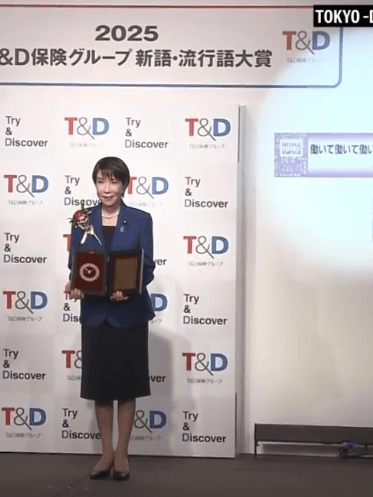
Japan’s first female prime minister, Sanae Takaichi, has sparked nationwide fascination not only for her political stance but also for her now-famous mantra about dedication. Her pledge to work endlessly for her country, expressed as work repeated five times, was selected as Japan’s catchphrase of the year. She first voiced the phrase in October after winning leadership of the ruling Liberal Democratic Party, prompting both admiration and concern in a society where overwork remains a persistent problem. Accepting the award, she stressed that her intention was enthusiasm, not encouraging unhealthy work habits.
Early Tensions and a Growing Political Spotlight
Shortly after taking office, Takaichi drew international attention by suggesting that Japan could consider military action should China attack Taiwan, triggering a sharp reaction from Beijing. Domestically, however, she has become a cultural phenomenon. Her structured workwear and minimalist aesthetic have inspired many women who follow her style, with social media users describing themselves as supporters of Sanae. Whether her conservative policies will inspire similar loyalty remains unclear.
Rebuilding a Party and Embracing Hard Work
Takaichi took the reins after major losses under former leader Shigeru Ishiba and has since tried to win back right-wing support. During an address to party members in early October, she pledged complete dedication to rebuilding the party, even declaring that she would abandon the idea of balancing work with personal life. Repeating the word work in a low, steady voice left a lasting impression among viewers.
Long Hours, Little Sleep and Moments of Rest
Reports of her long days and minimal rest have raised concerns among lawmakers. She once met with aides at 3 a.m. before the opening of parliament, and in November she admitted she sleeps only a few hours on most nights while also caring for her husband, who is recovering from a stroke. Takaichi says she relies on a morning and evening hot bath to unwind, describing it as her moment of peace.
A Fashion Icon Defined by a Single Bag
Her rise as a style icon has been fueled by a simple black handbag, known online as the Sanae Bag and officially named the Grace Delight Tote. Produced by Hamano, a Japanese leather-goods maker with a long history, the bag has captured national interest. Following her appearance with it on October 21 as she entered the prime minister’s office, demand surged across all eight available colors, which quickly sold out. With production limited due to craftsmanship standards, customers now face a months-long wait.
The Accessories That Sparked a Trend
Alongside the bag, a light-pink Jetstream pen made by Mitsubishi Pencil has also become popular after Takaichi was seen using it during meetings. Store supplies often sell out, and fans celebrate finding one as a sign of solidarity with the prime minister.
Admiration as a New Kind of Role Model
Experts note that the level of attention surrounding Takaichi is usually reserved for celebrities and athletes. Her influence demonstrates a shift in how Japanese women seek role models. Unlike traditional figures admired for femininity, Takaichi stands out through her assertive political identity, short haircut and functional wardrobe. Psychology professor Namiko Kubo-Kawai observes that even though Takaichi does not align with feminist ideals, she still fills a cultural gap for women who have never rooted for a prime minister before.
Conservative Values Behind the Image
Despite her new fashion-icon status, Takaichi holds firm conservative beliefs. She supports maintaining male-only imperial succession and opposes updating a 19th-century law that prevents married couples from keeping separate surnames. Her politics may limit her appeal among feminist groups, yet her presence marks a diversification of female role models in Japan.
A Leader Redefining Visibility
As Japan’s first female prime minister, Takaichi has stepped into an unusual dual space: a hard-line conservative figure and a growing cultural icon who inspires women through her determination and style. Even those who do not share her views recognize that she represents a new type of leader in a country where political and cultural expectations are rapidly evolving.